2023
Support at MYOB
Leading customer-centric initiatives to reduce support operational costs and increase customer satisfaction
TL;DR
MYOB historically relied heavily on phone calls to support their customers. Over time, it created a behaviour in which customers would pick up the phone any time they had a question. This led to an incredibly inefficient and expensive service that was impossible to scale.
In 2023, MYOB started a 3-year program with the goal of reducing operational costs of support while increasing customer satisfaction. Most of it relied on shifting phone support to new and improved digital channels. At the end of the first year, the whole program achieved great results.
Key contributions
Design leadership
Influencing and shaping customer experience
Stakeholder engagement
Leading customer-focused discussions
Design maturity
Explaining design and leading by example
Analysis and design
Shipping incremental value to the business
Design leadership and influence
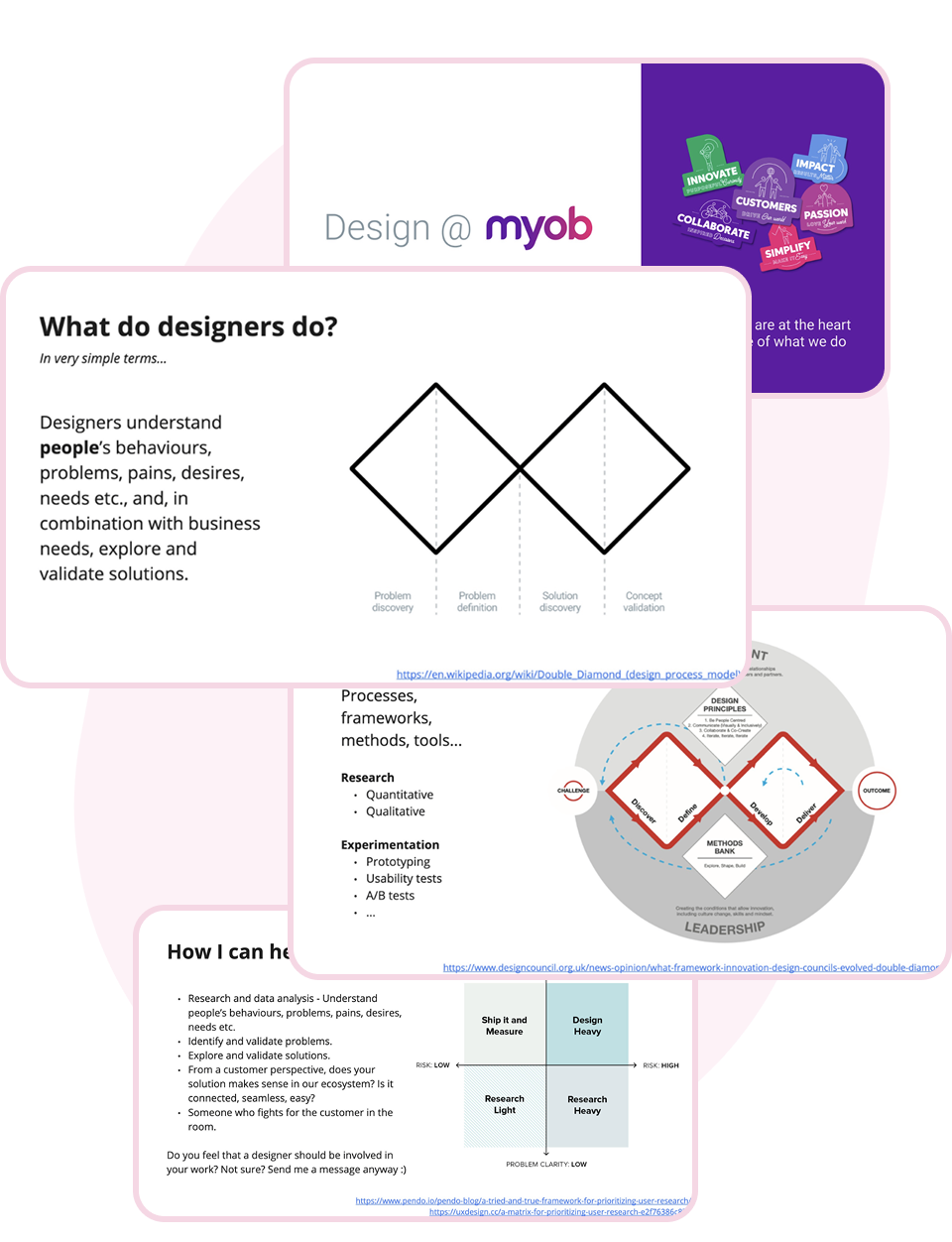
As a design leader, I was responsible for bringing a customer-centric approach to projects and leading by example. I was the first designer to ever join the Support group in the business and this meant that first I had to explain the design discipline, how designers work, and how design could help the team and the business. The images to the right are some slides of one of the sessions.
My participation was successful and, over time, support teams started collecting customer feedback, doing interviews, framing problems from the customer perspective, and testing solutions more frequently.
Reinventing the self-service journey
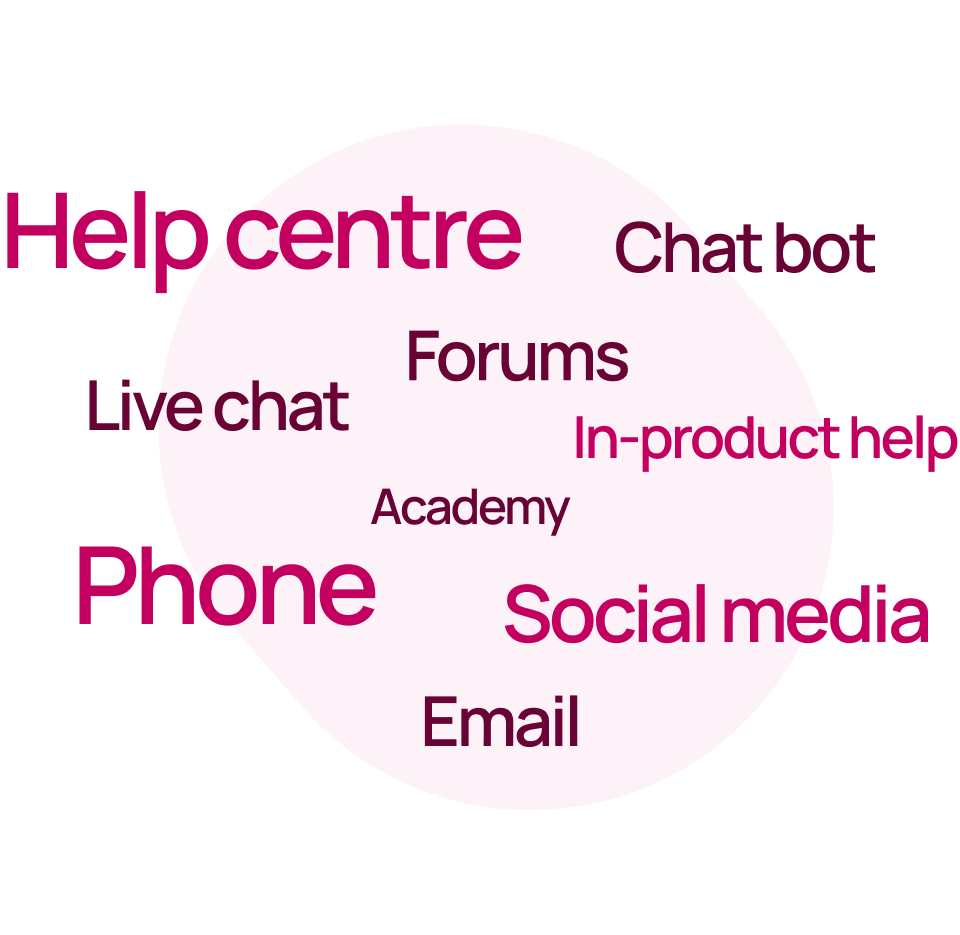
My biggest project of the year revolved around the results of my analysis of the support ecosystem, which revealed that it was too complex and disconnected. It relied on too many channels for customers to choose from and used complicated language, driving people to stick to phone calls as the safest, tried and tested option.
The project started with mapping the support journey, the channels, their entry points and dead-ends. The work showed that we needed to create a funnel, first directing users to self-service options, which were cheaper and more efficient, and then driving them to human-assisted channels as needed, more expensive to the business and time consuming to customers.
Below are some of the initiatives that I started to consolidate the self-service journey.
Simplifying the support language
As part of my initial analysis, it was clear that the language used to describe support channels was very confusing.
Therefore, I assembled and led a team of a design researcher and a product designer for a 3-weeks research initiative. The goal was to better understand what names and descriptions would resonate the best with customers.
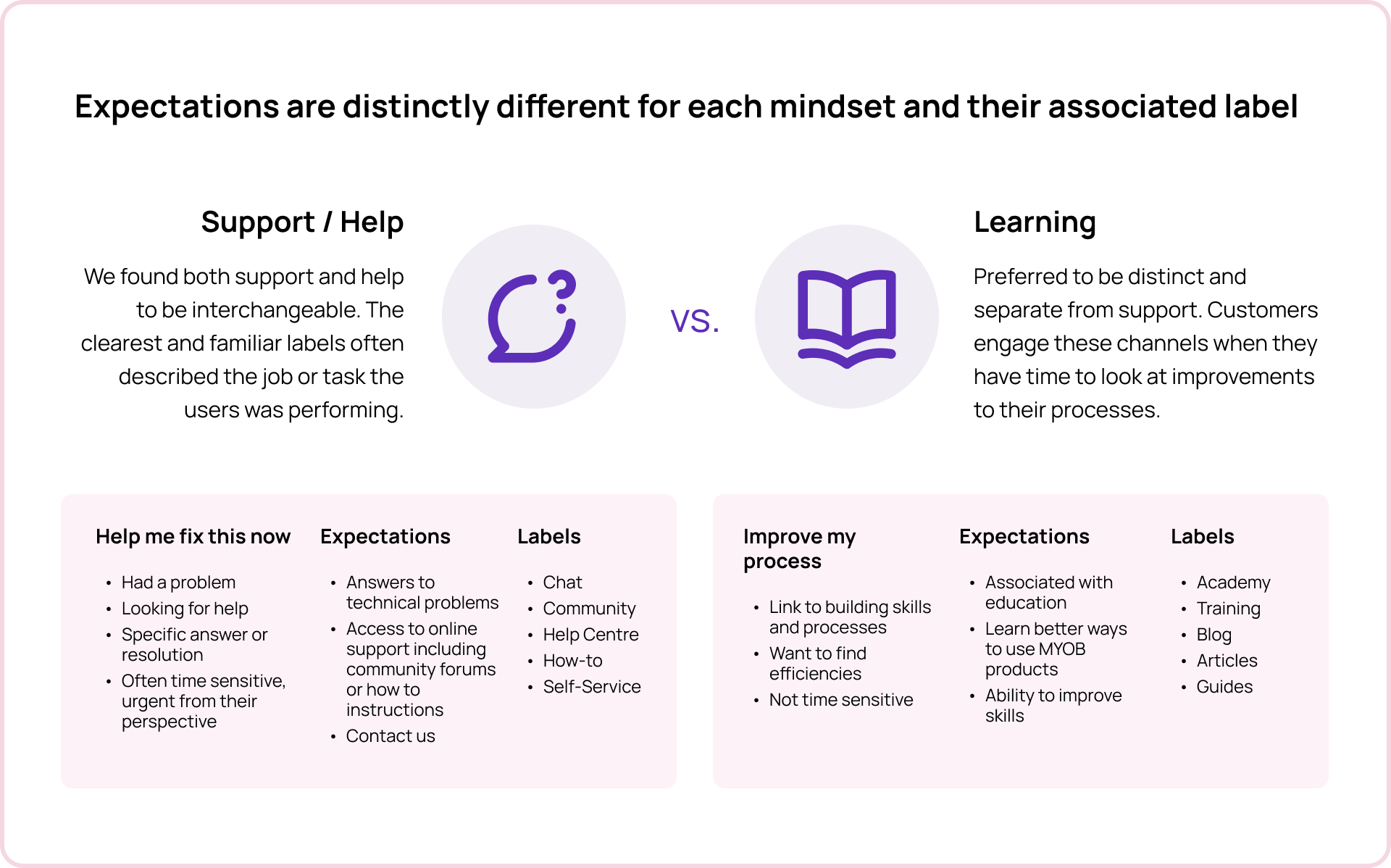
The image on the left is a slide of the report.
The biggest takeaway is that we were not matching customer expectations. The words Support and Learning were used interchangeably and at the same time, but that did not follow the customer mental model. Customers required support as a way of getting help now, with urgency, as opposed to learning that was done in a different time constraint, looking at the future.
This work led to several changes in our public website, reorganising support and learning content in different places, each one with a specific entry point in the main navigation. We also shared best practices with the support group, so they could make use of the learnings in their own projects, scaling the influence of our work.
Consolidation of a single support entry point
Over the years, MYOB created multiple support channels to help customers, e.g. help articles, guides, videos, chatbots, email, live chat, phone calls and many more. So, when the business would offer help, they listed all the channels and let the customers select one. Our analysis showed that people just wanted to get help, and all those options were overwhelming.
My proposed solution was to simplify the experience into one single entry point. From there, customers would find the best solutions depending on the problems they were facing.
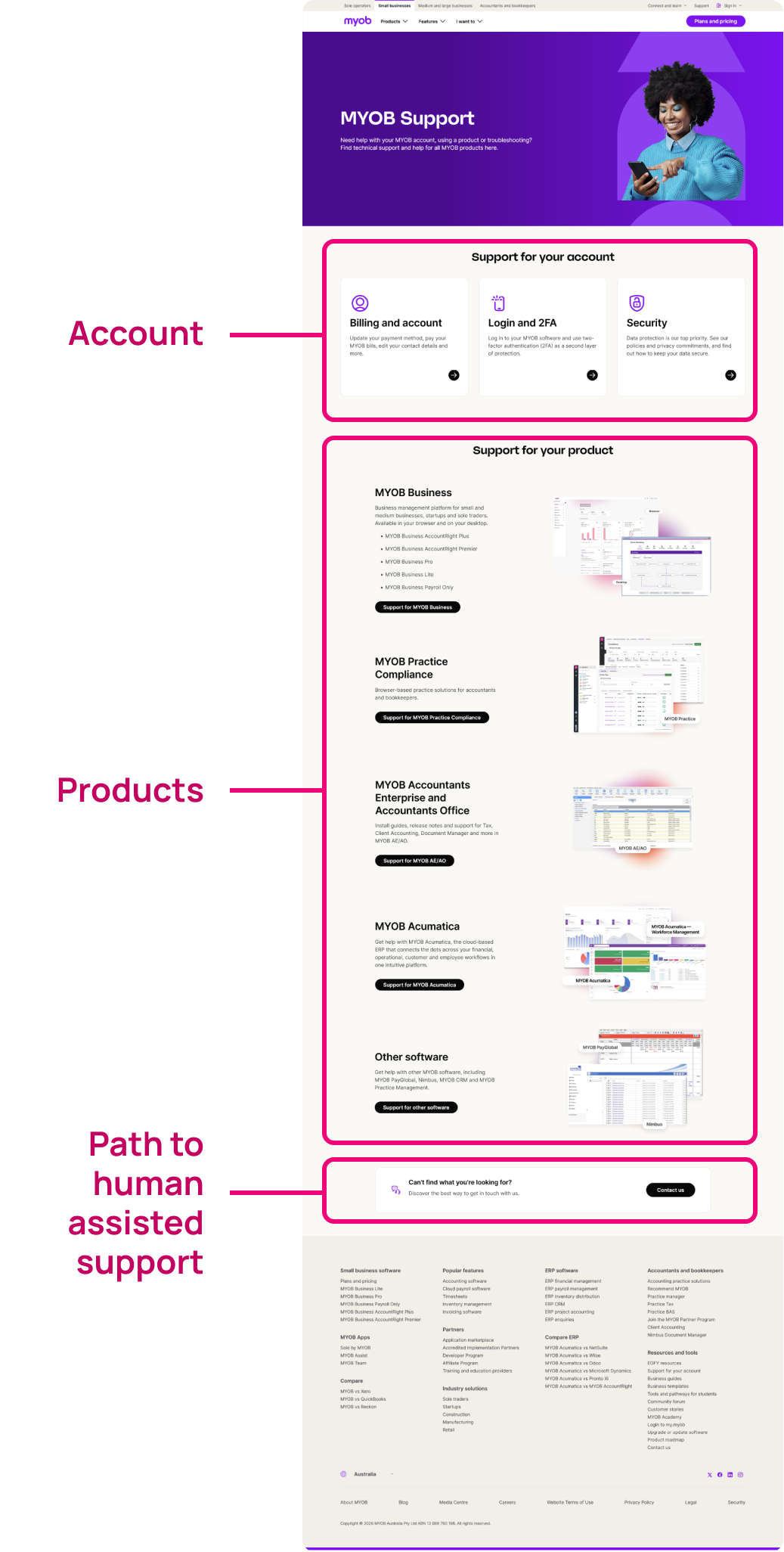
In partnership with the website team and content writers, we selected the page "myob.com/support" as the entry point. It was already one of the main areas of the website, and the URL was easy to remember. We removed mentions to learning options from this page and moved them to another place on the website. The page (on the right) was divided in three: started with the biggest call drivers related to account, billing and security, then product help divided by product, and the last item of the page was a shy link to "Contact us", which was used as the last resort.
The "Contact us" page was also redesigned, offering self-service options above the human-assisted channels.
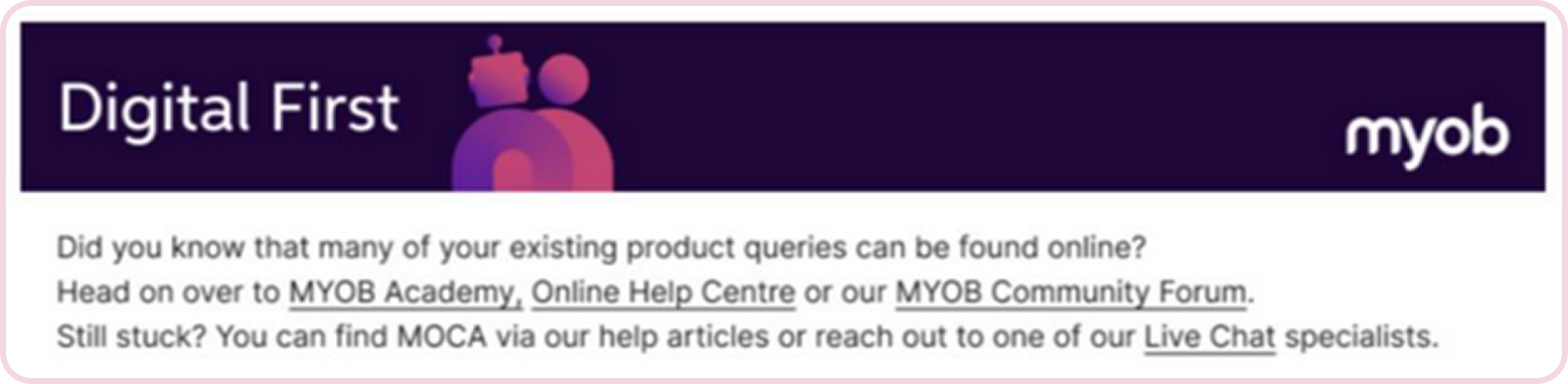
Another example of the entry-point consolidation was in the team member's email signatures below. Instead of listing all channels, I created a signature template that pointed to the single web address.

Adjusting online presence to disassociate support from phone calls
In 2022, phone calls represented 70% of all the support contacts. A simple Google search for "MYOB help" or "MYOB support" would automatically show MYOB's phone number printed on Google, above all the other search results. MYOB's website pages, help articles and community forum posts pointed to the phone number as the solution to any problem. Even the products had error messages telling people to call MYOB.
To change customer behaviour, we needed to change the business' online presence. For that, I did an extensive analysis, identifying all the places where our phone number was appearing online, and started removing them one by one, offering our single entry point of support (myob.com/support) as the main path.
We removed mentions of support phone numbers in our public websites and, in collaboration with the legal team, we kept the necessary ones but removed them from search engine crawlers. So, customers could find the phone numbers if they need to, but we would only offer it as the best option depending on the problem, not as an automatic muscle memory response from customers.
After 3 months, the phone numbers disappeared from search engines with no backlash from customers.
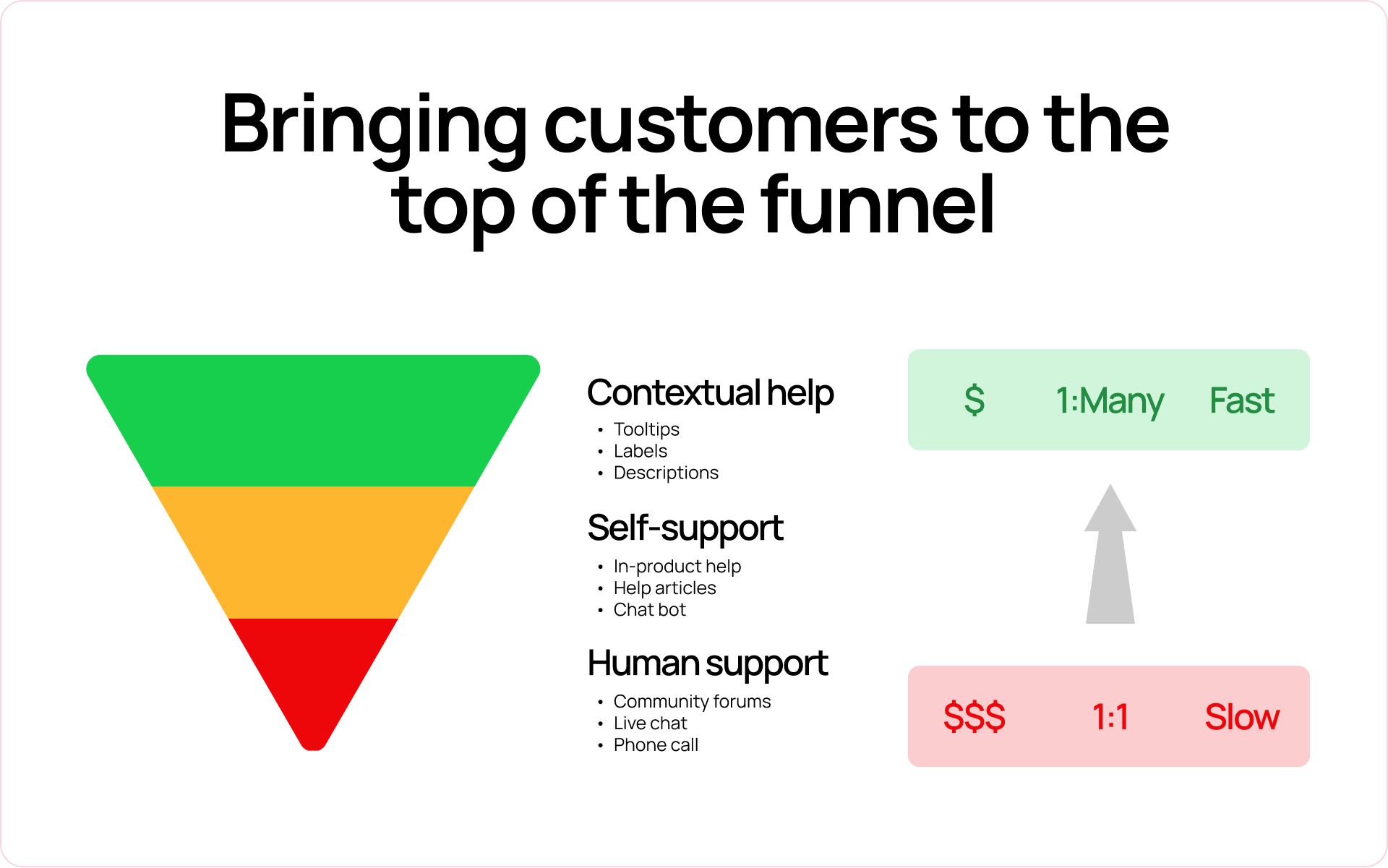
Scaling self-support thinking to product teams via "Digital First Playbook"
To become sustainable, the digital first approach had to be disseminated in the product teams as a company wide effort. Teams would have to change the way they were dealing with support to consider it as part of the project, instead of an afterthought.
To help with the mindset shift, we created a "Digital First Playbook" with best practices in support self-service in combination with a few workshops to help teams absorb the content. This material helped them understand why they should rely on self-service digital channels first.
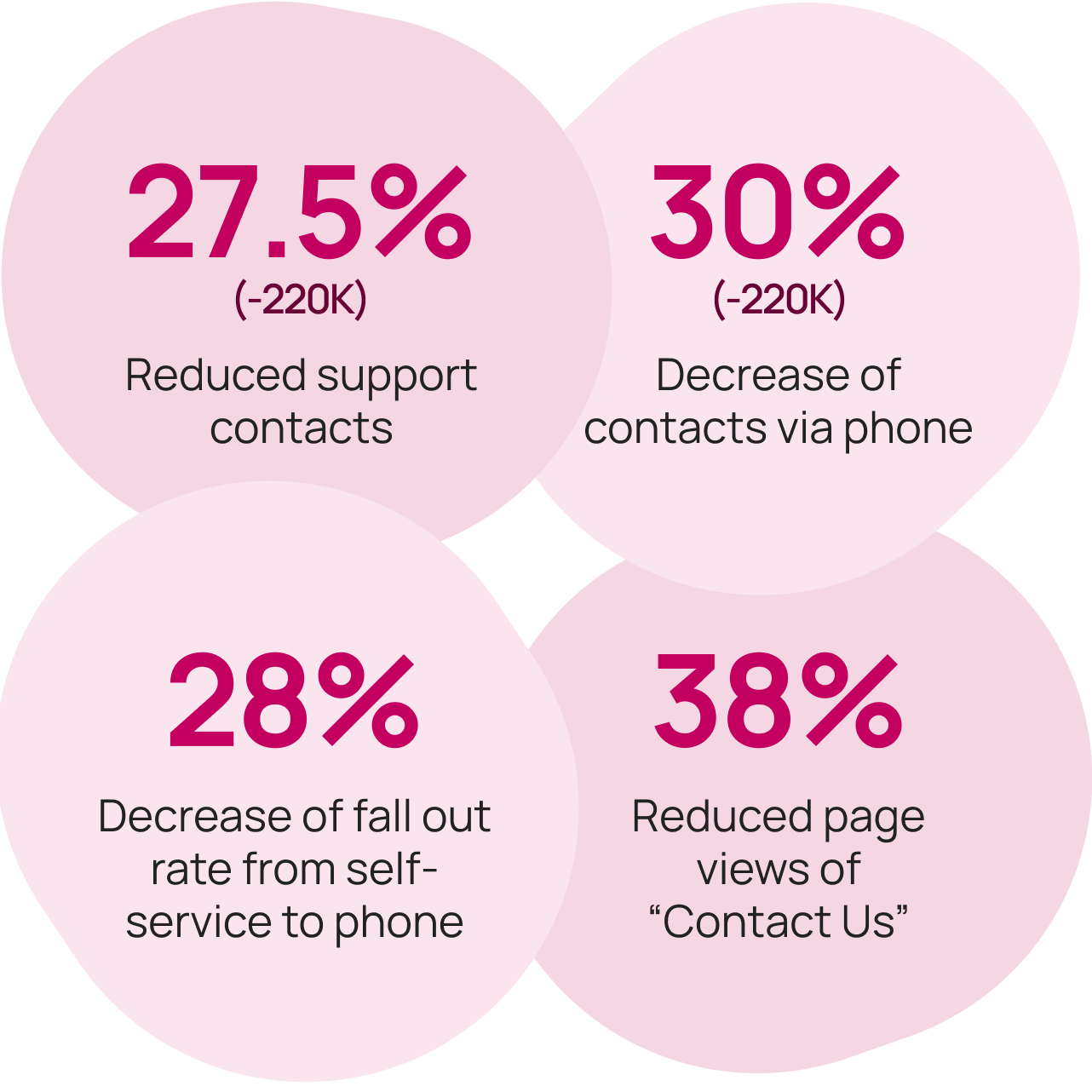
In one year, the program had strong results and increased overall customer satisfaction
I'm very proud of my participation in this massive transformation project. One of my favourite results was the 38% drop in page views of "Contact us", which was the last resort page on the website with phone numbers, demonstrating people were finding solutions to their problems by themselves.
Reducing the phone call volume also presented exponential benefits in customer satisfaction. The wait time to talk to someone was one of the main complaints at the time and it decreased from up to 2 hours in some situations to 10 minutes maximum.
Another metric of personal success that year was that at the end of Q2, I was nominated by a peer and I won a company wide award for my passion and dedication to the support group. Also, at the end of the year, the design team elected me as the winner for collaboration and contribution to the design community.